
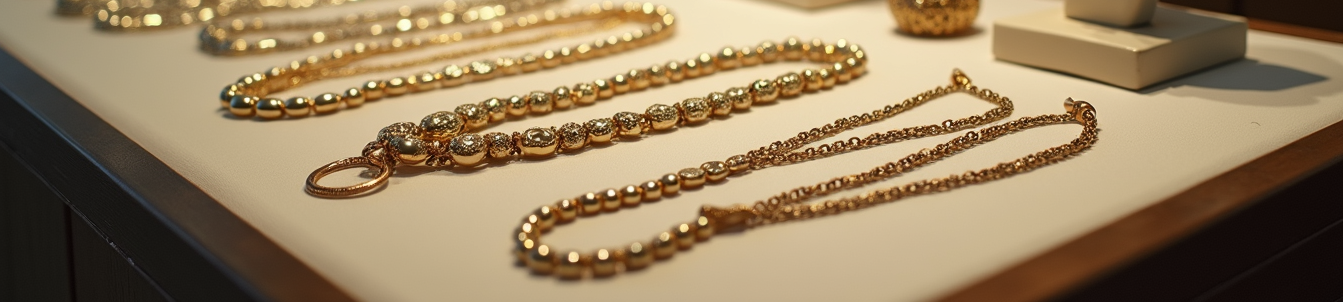
What are the different types of necklaces?
Necklace types are defined by their length, style, and chain structure, ranging from tight chokers (14-16 inches) to long opera or rope chains. Common styles include versatile pendants, elegant pearl strands, luxurious tennis necklaces, and bold statement pieces, often chosen to complement specific necklines.
Key Necklace Styles
Choker (14-16 inches): Sits high on the neck, ideal for open necklines.
Collar (12-13 inches): Rests directly on the collarbone.
Princess (18 inches): A standard, versatile length that sits near the collarbone.
Matinee(20-24 inches): Suited for casual or business attire.
Opera (30-36 inches): Long, versatile, can be worn as a single or double strand.
Rope (36+ inches): Very long, often includes drops or tassels.
Pendant: A small, decorative piece suspended from a chain.
Statement/Bib: Large, elaborate necklaces meant to be the focus.
Lariat (Y-Necklace): A long, rope-style necklace without a clasp that crosses over itself.
Station: A chain featuring consistently spaced jewels or ornaments.
Tennis: A continuous, flexible strand of diamonds or gemstones.
Chain: A plain metal chain without a pendant, such as cable, box, or rope.
Common Chain Types
Cable: Classic, interlocking oval links.
Rolo: Similar to cable, but with wider, rounded links.
Paperclip: Long, slender links resembling a paperclip.
Box: Square links that create a modern, sleek appearance.
Snake: Smooth, round, and flexible chain that mimics a snake's skin.
Figaro: Alternating flat links (usually one long with two or three shorter).
Herringbone: Flat, dense, parallel, and angled links

MEET KARIN
Like all rewarding journeys, Karin Jamieson’s path to becoming an award-winning jewelry designer has included a detour or two.
After successful post-collegiate turns as a travel agent, and then as a financial advisor for a major investment firm, Karin decided to pursue her life-long interest in gemstones and enrolled in a course at the Gemological Institute of America.
Her passion and talent for working with rare stones was obvious, and she soon received an offer from Tiffany & Co. to take a position in sales and earn her GIA Graduate Gemologist®️ Certification.
Graduate Gemologist® Program (gia.edu). It was here that Karin began to build a roster of private clients for her own designs.